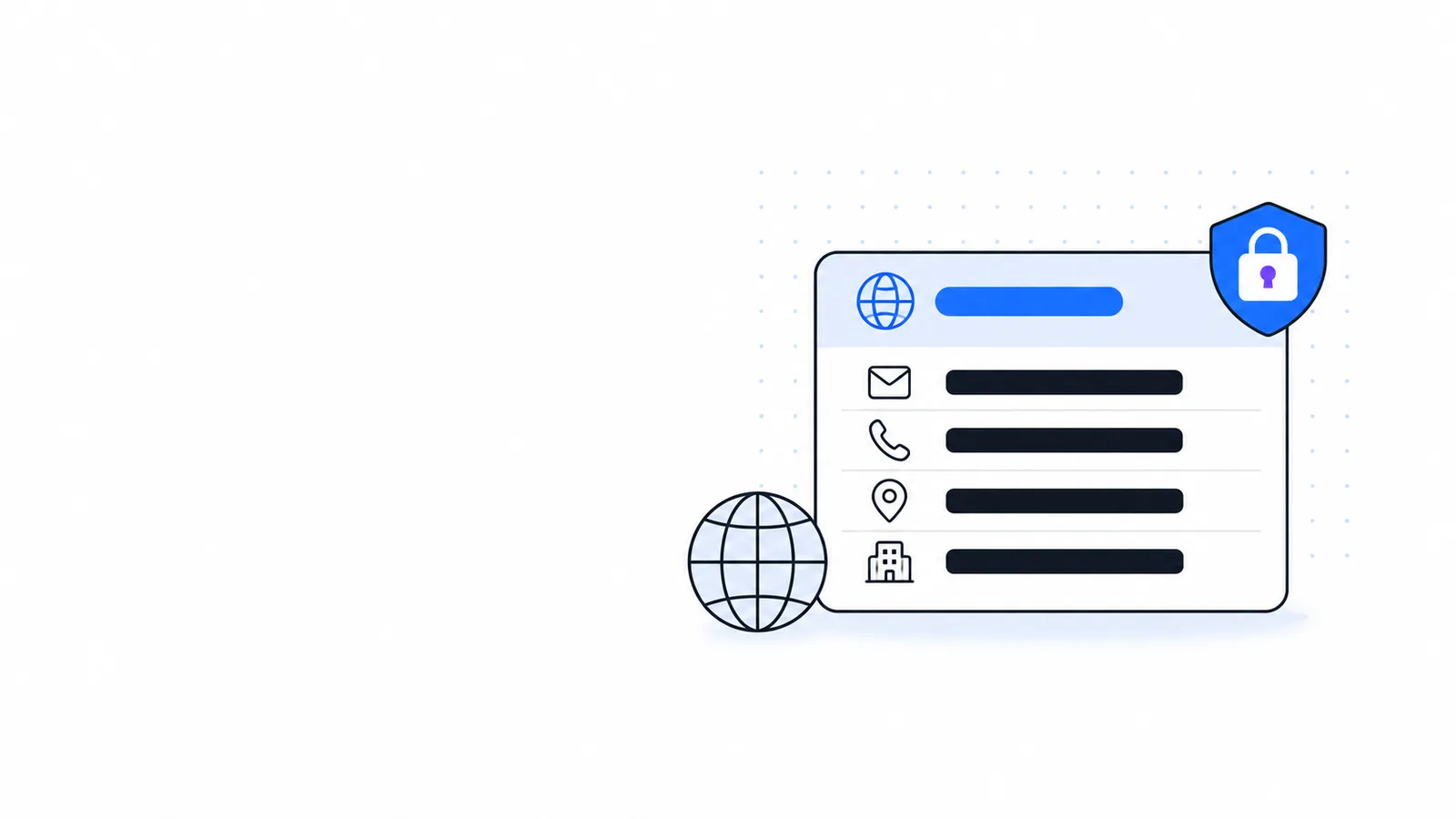


WHOIS privacy keeps your personal contact details out of the public registration record of your domain name. So what is WHOIS privacy hiding in practice? It hides your name, street address, phone number and email address, while the registrar, the dates and the name servers stay public. ICANN rules written after GDPR now make registrars redact much of this data on many domains, so a separate privacy service matters less than it once did.
Key takeaways
- WHOIS privacy removes or replaces the registrant's personal contact details in the public record. It never hides the registrar, the registration dates, the domain status or the name servers.
- There are two mechanisms. Your registrar can redact the fields, or a privacy or proxy service can publish its own contact details in place of yours.
- ICANN's Registration Data Policy took effect on 21 August 2025. It lists the fields a registrar must redact when redaction applies, and it keeps the country and the state or province public.
- Privacy does not hide you from your registrar. You must still give accurate contact details, and the registrar can disclose them after a valid request.
- To check a domain, run a lookup and read the registrant fields. A redaction marker or a privacy provider's name tells you which mechanism the domain uses.
What is WHOIS privacy?
When you register a domain name, the registrar collects your name, postal address, phone number and email address. For decades, registrars published those details in a public directory called WHOIS, which ICANN now calls the Registration Data Directory Service. Anyone could look up a domain and read who registered it.
WHOIS privacy is the general name for anything that stops your personal details from appearing in that public record. Registrars also sell or include it under names like domain privacy, privacy protection or ID protection. They all describe the same idea.
Since 28 January 2025, ICANN treats the Registration Data Access Protocol (RDAP) as the definitive source for registration data on generic top-level domains such as .com, in place of the older WHOIS services. Most people still say "WHOIS", and lookup tools still use the name, but the answer now usually comes from RDAP.
What WHOIS privacy hides and what stays public
ICANN's Registration Data Policy sets the rules for generic top-level domains. Section 9 of the policy lists which data elements a registrar publishes and which ones it redacts when redaction applies.
| Data in the record | What the public sees when redaction applies |
|---|---|
| Registrant name | Redacted |
| Registrant street and postal code | Redacted |
| Registrant phone and fax | Redacted |
| Registrant email | Replaced by an email address or a web form link that does not identify you |
| Registrant city | The registrar may redact it |
| Registrant organization | Published if you agree. If you do not agree, the registrar may redact it |
| Registrant state or province | Published if the registrar collected it |
| Registrant country | Published |
| Domain name, registrar and registrar IANA ID | Published |
| Creation date and domain status | Published |
| Name servers | Published |
| Registrar abuse contact email and phone | Published |
The policy also says how redaction must look. The registrar must leave the value out of the result and must show that it has redacted the value. The exact wording differs between registrars. An illustrative record looks like this:
Domain Name: example.com
Registrar: Example Registrar, Inc.
Creation Date: 2019-03-14T10:22:31Z
Domain Status: clientTransferProhibited
Registrant Name: REDACTED
Registrant Street: REDACTED
Registrant State/Province: Punjab
Registrant Country: PK
Registrant Email: https://registrar.example/contact-domain-owner
Name Server: ns1.example.net
The record above still tells a visitor which registrar to contact and gives them a way to send the owner a message. It does not tell them who the owner is or where the owner lives.
Redaction and privacy services are different things
People use "WHOIS privacy" for two mechanisms that work differently. Knowing which one a domain uses tells you what the record means.
Redaction by the registrar
With redaction, you stay the registrant and the registrar hides your personal fields in the public result. You do not sign up for anything extra. The registrar applies it under the Registration Data Policy, and your real details stay in the registrar's own records.
A privacy service
ICANN defines a privacy service as one where you register the domain as the registered name holder, so your name can appear in the registrant name field. The provider then publishes alternative contact details, such as a mail-forwarding email address, in place of your personal contact information.
A proxy service
With a proxy service, the provider is the registrant of record. ICANN notes that this is legally distinct from a privacy service, because the proxy provider is the registered domain name holder and licenses the use of the domain to you through its agreement with you. None of your information appears in the record.
| Who is the registrant of record | What the lookup shows | |
|---|---|---|
| Redaction | You | A marker that the registrar redacted the values |
| Privacy service | You | Your name can appear, with the provider's contact details |
| Proxy service | The provider | The provider's name and contact details |
When a domain uses a privacy or proxy service affiliated with the registrar, the policy tells the registrar to publish the service's full registration data. That is why some records show a complete name and address that belong to a privacy company and not to the owner.
What ICANN and GDPR changed
Before 2018, registrars published the registrant's full contact details unless the owner used a privacy or proxy service. The European Union's General Data Protection Regulation (GDPR) changed that. These are the dates that matter:
- On 17 May 2018, the ICANN Board adopted the Temporary Specification for gTLD Registration Data. It changed the registrar and registry agreements to comply with GDPR, and it took effect on 25 May 2018.
- On 28 January 2025, RDAP became the definitive source for gTLD registration data in place of the retired WHOIS services.
- On 21 August 2025, the Registration Data Policy took effect as the permanent ICANN consensus policy that followed the Temporary Specification.
The current policy does not order every registrar to redact every domain. A registrar must apply the redaction rules where applicable law requires it to redact personal data. A registrar may also apply the same rules more widely if it has a commercially reasonable purpose, or if it cannot technically limit redaction to the cases the law covers. The registrar may consider where the registrant is located and whether the registrant is a legal person, but the policy does not require it to.
In practice, two owners with different registrars can see different results for similar domains. The policy also gives you a choice in the other direction. When a registrar redacts your data, it must offer you the chance to consent to publication, and it must publish the values you consent to.
What WHOIS privacy does not do
WHOIS privacy limits what a public lookup shows. It leaves several things unchanged.
- Your registrar still holds your real details. ICANN's registrar agreement requires registrants to give accurate contact details and to update them within seven days of a change. If you give false details, or do not answer the registrar's accuracy inquiry for more than 15 days, the registrar may suspend or cancel the registration.
- Third parties can still ask for your data. Each registrar must publish how to send a disclosure request, must consider each properly formed request on its merits, and must respond within 30 calendar days of acknowledging it unless exceptional circumstances apply. ICANN also runs the Registration Data Request Service, which passes requests for nonpublic data to the registrars that take part. The registrar decides whether to disclose.
- People can still contact you. The email address or web form in the record forwards messages to you without showing your address.
- Your DNS stays public. Name servers appear in the record, and anyone can query your DNS records with a tool such as a DNS lookup.
- Country-code domains follow their own registry's rules. The Registration Data Policy applies to ICANN-accredited registrars and gTLD registry operators, so check the registry's policy for a country-code extension before you rely on privacy there.
When WHOIS privacy is worth having
Run a lookup on your own domain first. If the record already shows your personal fields as redacted, a separate privacy service adds little. If the record shows your details, privacy is worth turning on in these cases:
- You registered the domain as an individual and the contact address is your home.
- You are a sole trader or freelancer who uses a personal phone number and email address for the business.
- You run a site on a sensitive subject and do not want your name linked to it in a public directory.
- You are registering a name for a project you have not announced yet.
Privacy is a weaker fit in other cases. A registered company often wants its organization name in the record, because it shows customers and partners who operates the domain. A proxy service also deserves a careful read of the terms, because the provider becomes the registered holder of the name and you use the domain under an agreement with that provider.
Before you register a new name, at WaseerHost's domain registration page or anywhere else, check how the registrar handles privacy for the extension you want.
How to check if a domain has WHOIS privacy
A lookup works for your own domain or anyone else's.
- Open the WaseerHost WHOIS lookup, or ICANN's lookup tool at
lookup.icann.org. - Type the bare domain, for example
example.com, withouthttps://or a path. - Find the registrant section of the result.
- Read the registrant name, street, phone and email fields.
What you see tells you which mechanism applies:
- A marker that the value is redacted means the registrar applied redaction.
- A company name that describes a privacy or proxy service, with a forwarding email address, means the domain uses a privacy or proxy service.
- A person's name, street address and phone number mean the record has no privacy at all.
- An organization name with a country, next to redacted street and phone fields, is normal. The policy keeps the country public and lets the owner agree to publish the organization.
If your own details still show
- Sign in to your registrar account and open the domain's contact or privacy settings. Turn on the privacy option if the registrar offers one for that extension.
- Check whether you agreed to publish your data. Under the ICANN policy, the registrar publishes the values you consented to.
- Look at the organization field. If you typed your own name there, the registrar may publish it as an organization.
- Ask the registrar whether it applies redaction to your domain. The policy requires redaction only where the law requires it, and each registrar decides how much further to go.
- Run the lookup again after you save the change.
Frequently asked questions
It depends on what your record shows today. If a lookup already shows your name, address, phone and email as redacted, you have the main benefit without a separate service. If the lookup shows your personal details, turn privacy on, especially when the address is your home.

Written by
Web & AI Systems Lead
Web and AI Systems Lead at Wasevo, the company behind WaseerHost. He builds web applications and AI systems.